Super Mario 64 showed how 3D platforming could work. Released in Japan in 1996 alongside the Nintendo 64, it gave players free movement in open 3D worlds, an analog stick built for precise control, and a controllable camera, ideas that still shape 3D action games today. This page covers the game’s history, its different versions, the official ways to play it now, and how to run your own copy on PC.
Super Mario 64 at a Glance
| Platform | Nintendo 64 |
|---|---|
| Developer | Nintendo EAD |
| Publisher | Nintendo |
| Director and producer | Shigeru Miyamoto |
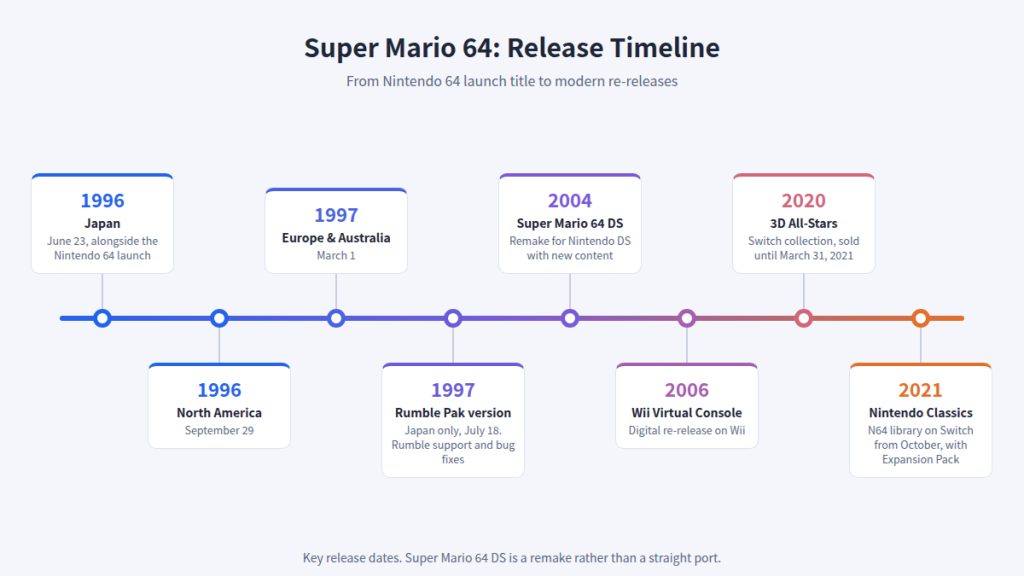
| Release dates | Japan: June 23, 1996 North America: September 29, 1996 Europe and Australia: March 1, 1997 |
| Genre | 3D platformer |
| Players | 1 |
About the Game
Princess Peach invites Mario to her castle, but Bowser gets there first, imprisoning everyone inside and stealing the castle’s Power Stars. The castle becomes a hub: paintings on its walls lead into self-contained worlds, and collecting stars opens new doors and areas.
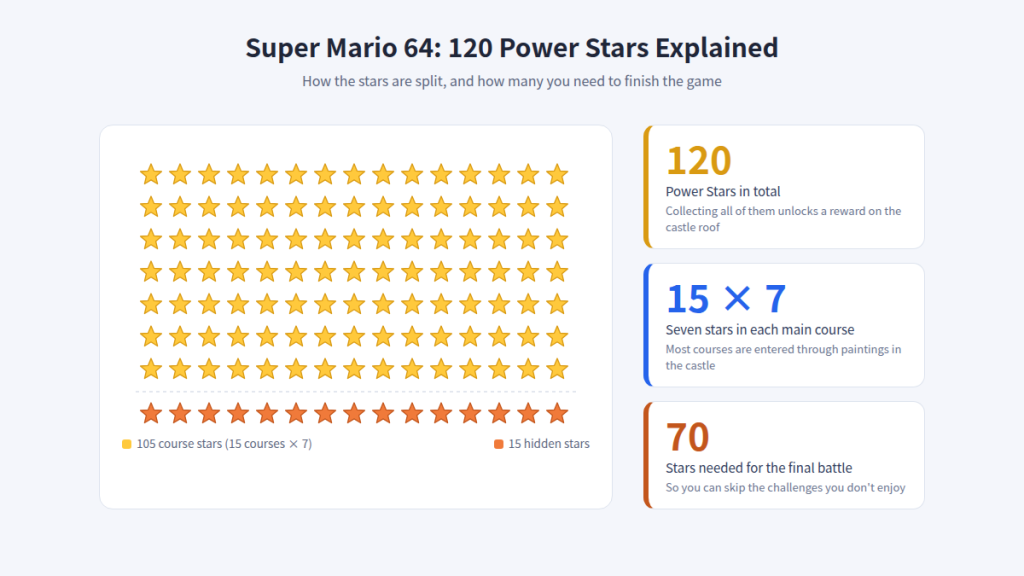
There are 120 Power Stars in total: seven in each of the 15 main courses, plus 15 hidden around the castle and in secret stages. Only 70 are needed to reach the final battle with Bowser, so players can choose which challenges to tackle. That freedom was unusual in 1996, when most platformers still followed a fixed path from start to finish.
The controls are the reason the game still feels good to play. Mario’s speed depends on how far you push the analog stick, and his move set includes long jumps, triple jumps, wall kicks, and backflips. The C-buttons rotate a camera operated, in the game’s story, by a Lakitu cameraman.
Versions and Re-Releases
- Original release (1996–1997): the Nintendo 64 cartridge.
- Rumble Pak version (1997, Japan only): often called the “Shindou” version. Released on July 18, 1997, it added Rumble Pak support, included the English version’s voice acting, and fixed various bugs.
- Super Mario 64 DS (2004): a remake for the Nintendo DS with additional playable characters and new content. It’s a separate game, not a straight port.
- Wii Virtual Console (2006): a digital re-release for the Wii.
- Super Mario 3D All-Stars (2020): a Nintendo Switch collection that included Super Mario 64. Nintendo sold it for a limited time, until March 31, 2021.
- Nintendo 64 – Nintendo Classics (2021 onward): Super Mario 64 has been part of Nintendo’s N64 library on Switch since it launched in October 2021.
How to Play Super Mario 64 Today
The simplest official way is the Nintendo 64 – Nintendo Classics app, which requires a Nintendo Switch Online + Expansion Pack subscription. Super Mario 64 has been in the library since it launched in October 2021, and the app is also available on Nintendo Switch 2.
If you still have the original hardware, the cartridge works on any Nintendo 64. Super Mario 3D All-Stars is no longer sold digitally, but physical copies still circulate secondhand.
Playing Your Own Copy on PC
If you own the cartridge, you can make a backup and play it in an emulator on PC. Dumping a cartridge requires a dedicated dumping device. Our guide to legally backing up your own cartridges and discs explains the process and the legal points to keep in mind, which vary by country.
Super Mario 64 is one of the best-supported games in N64 emulation. The main options are:
- simple64: a standalone N64 emulator focused on accuracy and easy setup.
- RetroArch with Mupen64Plus-Next or ParaLLEl N64: useful if you already play other systems in RetroArch and want one controller setup for everything. Our comparison of RetroArch vs standalone emulators explains the trade-offs.
As with any game, performance depends on your hardware, the emulator, and its settings.
Controller Setup
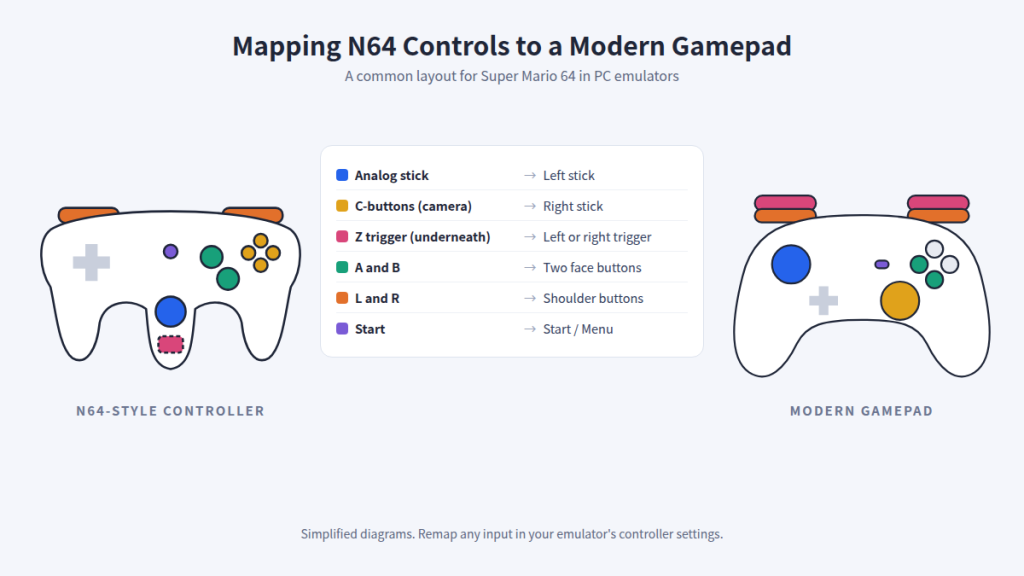
The N64 controller’s three-prong design has no exact modern equivalent, but Super Mario 64 maps well to a standard gamepad:
- Analog stick: left stick. A precise stick matters here, because Mario’s walking and running speed depends on how far you push it.
- C-buttons: right stick, used for camera control.
- Z trigger: left or right trigger, used for crouching, long jumps, and backflips.
- A and B: two face buttons for jump and attack.
If you’re choosing a controller, our guide to the best controllers for emulation covers what matters for N64 games.
Graphics Tips
- Internal resolution: most N64 emulators can render well above the original resolution, which makes the game’s simple geometry look much sharper on a modern display.
- Aspect ratio: the game was designed for 4:3 screens. Keep 4:3 for the correct picture unless you’re using a dedicated widescreen hack.
- Accuracy over speed: if you see glitches, try the emulator’s more accurate graphics plugin or core before changing anything else.
A Note on Fan PC Ports
In 2019, fans finished a full decompilation of Super Mario 64 into C source code, which led to unofficial native PC ports with features like widescreen and high frame rates. These projects don’t include the game’s assets: building them requires a copy of the game. Nintendo has taken copyright action against distributed builds and videos, so ROMSFUN does not link to them.
Why Super Mario 64 Still Matters
Nearly 30 years later, Super Mario 64 remains one of the most influential games ever made. Speedrunners still find new tricks in it, and its approach to camera control and open level design influenced 3D platformers for decades. Whether you play it on Switch, on original hardware, or from your own backup on PC, it holds up remarkably well.