
Story and Setting
Dr. Eggman builds a new robot, Gemerl, from the remains of Emerl from Sonic Battle. He then uses the Chaos Emeralds to perform Chaos Control, an experiment that goes awry and splits the globe into seven pieces. Sonic and Tails part from Knuckles, Amy, and Cream, and Eggman aims to control each piece.
As in most 2D Sonic games, the story is light. Its main purpose is to explain why your pals are scattered and how the other three characters join your roster; you rescue them from Eggman as you go along.
Gameplay: How Sonic Advance 3 Plays
The basics are classic Sonic. Rings are health; you start with three lives, and each act has a 10-minute timer. Levels include platforming with fast slopes and loops, springs, grind rails, and adversaries.
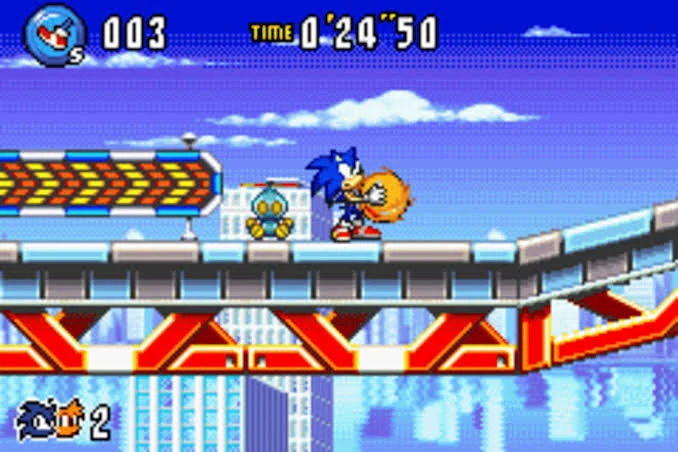
The big difference is the partner. Your second character follows you, collects rings, attacks enemies, and most crucially, modifies your moveset. Once charged, the R button will trigger a two-character tag maneuver. For instance, a tag move with Tails as a partner sends both characters flying.
Team selection also influences routes. Nintendo World Report review notes that only Knuckles can smash through some walls, and flying teams may reach high passageways more easily. The game ranks you by completion time, so there is no single “right” way to get a high score; you can choose whichever route works best for your team.
Characters and Team Combinations
There are five playable characters:
- Sonic: speed and a mid-air spin attack. Available from the start.
- Tails: flight. Available from the start.
- Amy: hammer attacks. Rescued during the game.
- Knuckles: gliding, wall-climbing, and wall-breaking. Rescued during the game.
- Cream: flight, with her Chao, Cheese, attacking enemies. Rescued during the game.
Any character can lead, and any other can partner, which makes 20 combinations. The partner decides which extra moves the leader gets. For example;
- Sonic as partner gives the leader a boost mode, useful for speed-focused runs.
- Knuckles as partner turns Tails’s flight into a glide, which Nintendo World Report also noted.
- Sonic leading with Tails is the balanced starter team, combining speed with tricks and easy flight from the tag move.
- Sonic leading with Cream adds flight and lets Sonic use Cheese as an attack.
- Tails leading with Amy gives a fast hammer-powered flight that lasts about three seconds.
For newcomers, Sonic and Tails are the easiest way in. Once you’ve rescued Knuckles, a team that includes him opens up the wall-breaking routes.
Levels, Bosses and Progression
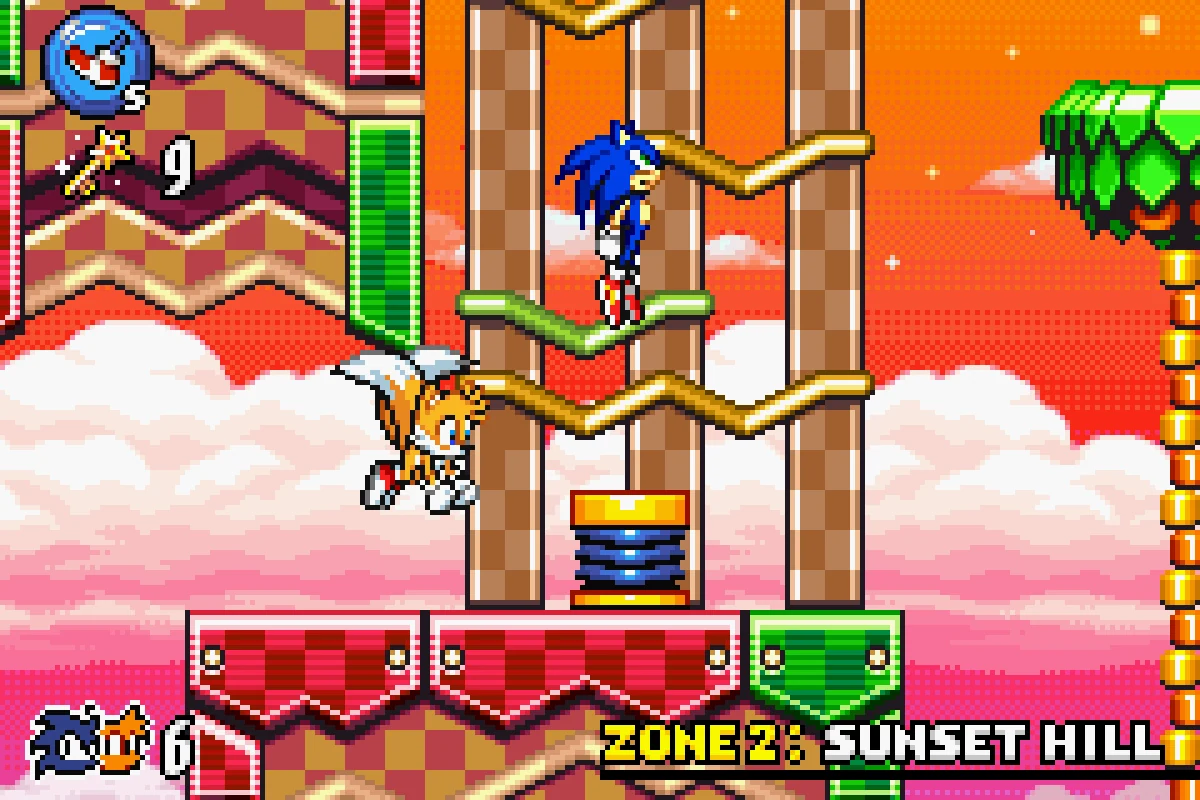
The game has seven zones, each with three acts and an Eggman boss battle. The zones are Route 99, Sunset Hill, Ocean Base, Toy Kingdom, Twinkle Snow, Cyber Track, and Chaos Angel. Each zone includes a small hub world that connects its acts, boss, and two minigames that provide extra lives instead of a world map. If one act is causing you difficulty, you can drop it and try another.
Chao hides in every act. Collect all 10 Chao in a zone to access a special stage, where you can earn a Chaos Emerald. After the 7 zones, you fight Eggman at the Altar Emerald. If you beat him there without all seven Emeralds, you get the usual ending. With all seven, you get Nonaggression, an additional final boss that unlocks the true ending.
Graphics, Music and Performance
Multiplayer and Link-Cable Features
The game supports 1-4 players using Game Boy Advance link cables. There are two kinds of multiplayer:
- Co-op: a second player controls the partner during the main game. Nintendo World Report notes that the second player needs their own copy of the game.
- Battle modes: up to four players compete in races or Chao-collecting matches, choosing any character.
Multiplayer is a bonus, not the game’s core. Everything important, including the Emeralds and the true ending, is in single-player.
Sonic Advance 3 vs. Sonic Advance and Sonic Advance 2
| Sonic Advance | Sonic Advance 2 | Sonic Advance 3 | |
|---|---|---|---|
| First released | December 2001 (Japan) | December 2002 (Japan) | June 2004 (North America) |
| Characters | Sonic, Tails, Knuckles, Amy | Sonic, Cream, Tails, Knuckles, Amy (unlockable) | Sonic, Tails, Knuckles, Amy, Cream, played in pairs |
| Main idea | Classic-style Sonic | Pure speed | Teamwork and exploration |
| Special stages | Hidden springs in certain acts | Collect 7 special rings in an act | Find 10 Chao across a zone |
| Structure | Linear zone order | Linear zone order | Hub world per zone |
| Metacritic | 87 | 83 | 79 |
Advance 2 suits players who want the fastest Sonic experience, and Advance 1 is closest to the Genesis games. Advance 3 is the most varied of the three, but it comes with a more complicated control scheme.
Is Sonic Advance 3 Still Worth Playing?
Yes, for the right player. If you liked Sonic Advance 2 but wanted more to explore, Advance 3’s team system and branching levels offer more variety than either earlier Advance game. It held a 79 on Metacritic and won Handheld Game of the Year at the 2004 Golden Joystick Awards, so its reputation isn’t just nostalgia.
Newcomers should expect a learning curve. Twenty combinations take time to understand. Players who only want straightforward speed may prefer Sonic Advance 2.
Access is the biggest practical problem. Sonic Advance 3 was re-released on Wii U Virtual Console in Japan in 2016, but as of October 2026, we couldn’t find any official modern release outside Japan, and in 2024 Sonic Team said it had no current plans to remake the Advance series. The original cartridge remains the official way to play, and if you own one, our guide to backing up games you own explains how. For classics you can buy or stream on current consoles, see our guide to retro games you can play legally without emulators.